



Stamped parts keep getting finer, and cleanliness requirements keep getting stricter. At the 6th Expert Meeting on Stamping Technology at MTI, RWTH Aachen University, Joachim Ritter and Peter Petzold from the Ecoclean Center of Competence in Monschau showed why “particle-free” is today’s benchmark — and which processes stamping companies can use to achieve it.
Stamping Meets Cleanliness: The Expert Meeting in Aachen
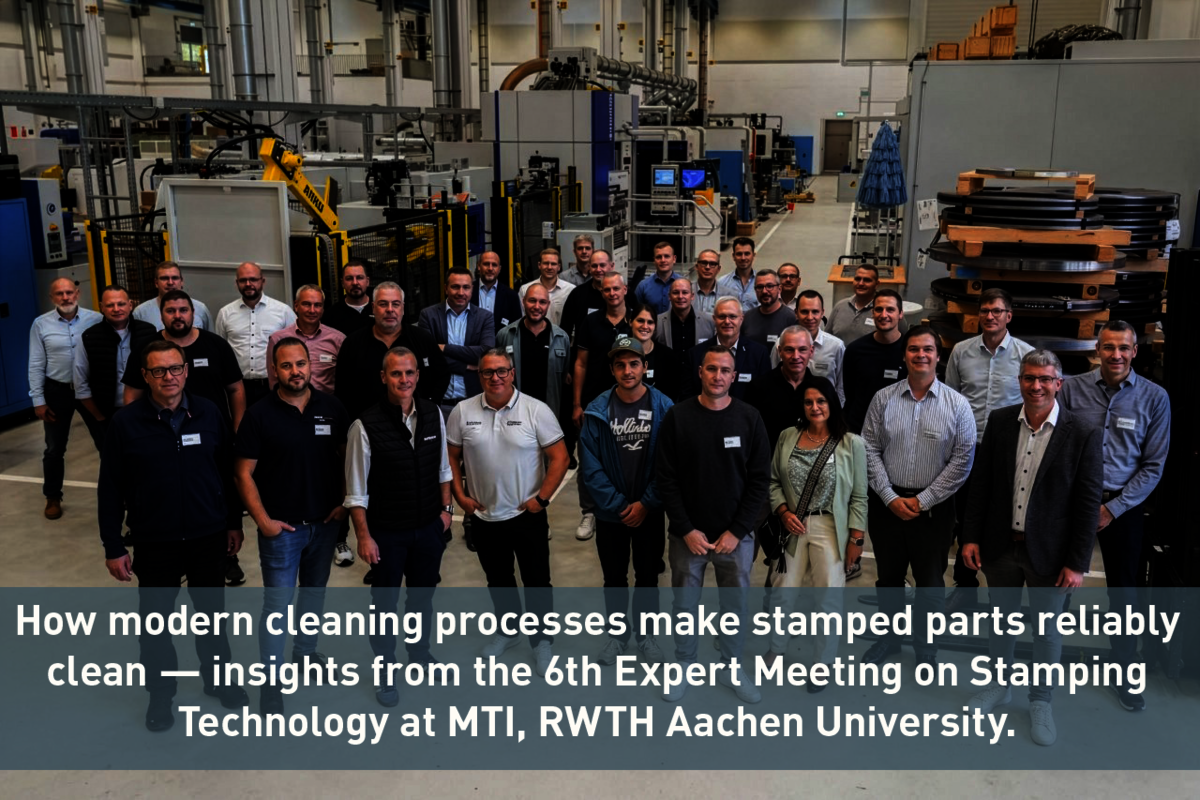
On October 1, 2026, experts in stamping and forming technology met at the Manufacturing Technology Institute (MTI) of RWTH Aachen University. The guiding question of the day: How can stamping processes be made more efficient, more reliable, and more productive? The expert meeting was hosted by Raziol, Unidor TR systems, FIBRO, and Ecoclean.
Between lubricant application, process monitoring, and material handling, one question came up that many stamping companies don’t face until the end of the process chain: What happens to the part after it leaves the press? Joachim Ritter answered it in his presentation “Particle-Free: Modern Cleaning Processes for Industrial Manufacturing.” After all, the performance of a stamped part is often determined during the cleaning process.
Why Parts Cleaning? Because “Clean” Now Means “Particle-Free”
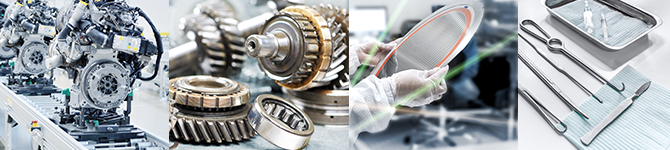
Stamping leaves its mark: stamping and cutting burrs, flash burrs, metallic and nonmetallic particles, fibers, and residues of embossing and stamping oils. This may seem insignificant on a single part, but in a battery cell, fuel cell, or electronic component, a single particle can cause a short circuit, leaking adhesive bond, or failure.
The range of parts that stamping companies need to clean today is wide:
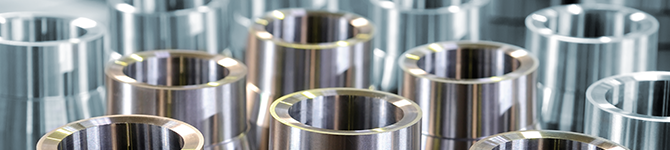
- Materials: stainless steel, aluminum, copper, titanium, platinum, gold, plastics, ceramics, graphite.
- Workpieces: coil materials, bipolar plates, battery components and battery cell housings, reel-to-reel stamped components, housing components, electrical connectors, electrical components, plastic trays.
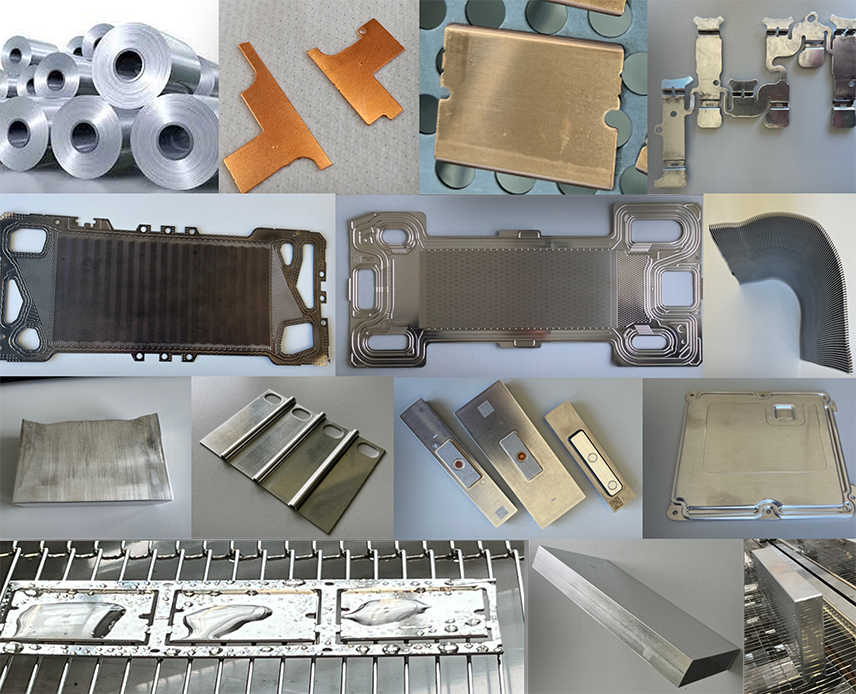
These components are used in forward-looking industries such as e-mobility, hydrogen technology, and medical technology, where component cleanliness determines function and service life. Joachim Ritter sums up the requirement in one word: particle-free. That doesn’t mean “looks clean,” but rather: defined, measurable, and reproducibly clean.
From “Clean and Dry” to 50 µm: How Requirements Have Changed
Joachim Ritter recalls that when he started out in the parts cleaning industry 40 years ago, a glance and a cloth were all it took. Today, particles are counted and classified by size, and surfaces are chemically analyzed. Here’s his overview of how things have evolved since then:
Period | Requirement | Method |
Until the 1980s | “Clean and dry” | Visual inspection |
Until the 1990s | Amount of residual contamination, e.g., max. 5 mg of chips | Gravimetric analysis (weighing) |
Late 1990s | Additionally, maximum particle size, e.g., max. 1,000 µm | Microscopic analysis |
2000s | Maximum number of particles per size class, separated into metallic and nonmetallic | Particle analysis on a filter membrane |
Today | Particles max. 50 µm with increasingly fine size classes; plus limit values for film-type contamination (36 to 50 mN/m) and no organic or substance residues such as sulfur, silicon, or carbon | Contact angle measurement, XPS analysis (X-ray photoelectron spectroscopy) |
For stamping companies, this means cleanliness is no longer a matter of feel but a test characteristic with a limit value. A typical example from the presentation: Stamping and cutting burrs must be removed, metallic particles must be eliminated down to a maximum of 100 µm, and nonmetallic particles down to a maximum of 1,000 µm. Anyone who wants to reliably achieve these values needs the right process — and proof.
The Right Process for Every Stamped Part
There is no single cleaning technology for stamped parts. Which process fits depends on geometry, quantity, contamination, and the target cleanliness level. Joachim Ritter distinguishes between two basic approaches: wet cleaning with water (usually with surfactant-based cleaners) or solvents, and dry cleaning, for example with moving air flows.
Ecoclean processes at a glance:
Process | Typical Use for Stamped Parts | Strengths & Benefits |
Low-pressure spray cleaning | Chemically assisted removal of greases, oils, and particles | Flexible for different part sizes; simple, low-maintenance technology |
Ultrasonic cleaning | Fine cleaning | Highly effective on the finest contamination |
Injection flood washing (IFW) | Extremely complex geometries and cavities | High cleaning performance, fast and effective |
Steam cleaning | Degreasing, fine cleaning, sterilizing | Spot-free, substance-free, chemical-free, low water consumption |
Hydrocleaning | Geometrically simple parts in high volumes | Very fast, spot-free, very low liquid consumption |
CO2 blasting | Targeted treatment of specific areas | Dry, no additives, removes particles, flash burrs, and soot residue |
Laser cleaning | Targeted treatment of specific areas | Pinpoint precision, degreases, removes flash burrs and soot residue |
Low pressure plasma cleaning and degreasing | Ultra-fine cleaning, activation, and functionalization of surfaces | Removes organic, molecular, and atomic substances, even in undercuts |
High-pressure water-jet deburring | Flash burrs, drilling chips, stubborn deposits | Deburring and cleaning hard-to-reach areas in a short time |
Pulsated Pressure Cleaning (PPC) | Internal cleaning of the smallest channels, bores, and capillaries | Independent of part geometry |
Thermal oil removal | Light embossing and stamping oils | Residue-free, dry, chemical-free, extremely fast |
From Single Parts to Production Lines: The Right System
These processes are built into systems for very different throughputs. In his second Ecoclean presentation of the day, titled “Cleaning with a System: An Overview of Industrial System Types,” Joachim Ritter took a closer look at this range:
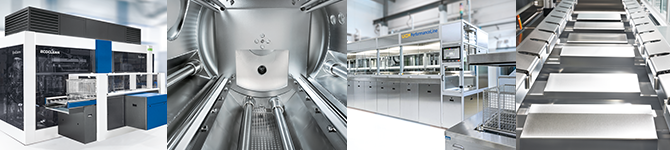
Chamber systems for batch cleaning: from the manual UCMCombiLine for low throughput (double-frequency ultrasound, up to 120 liters of working volume) to the compact EcoCcube (up to 80 kg per batch, up to 12 batches per hour) and the EcoCwave, the all-round talent for aqueous parts cleaning with flood, spray, and ultrasonic cleaning plus vacuum drying. For solvent cleaning, there is the EcoCcore.
Precision cleaning: The UCM Performance Line is a modular, multi-stage ultrasonic immersion cleaning system designed for the highest standards. It features mono-, twin-, or multifrequency ultrasound ranging from 25 to 120 kHz and megasonics, and optional Pulsated Pressure Cleaning (PPC) for complex geometries.
Robotic cells for cleaning and deburring: the EcoCflex 3 for flexible single-part cleaning with high-pressure applications, and the EcoCvelox for high-pressure water-jet deburring with cycle times of 15 seconds per pallet.
Transfer systems: the EcoCtrans, the workhorse for high throughput and short series cycle times.
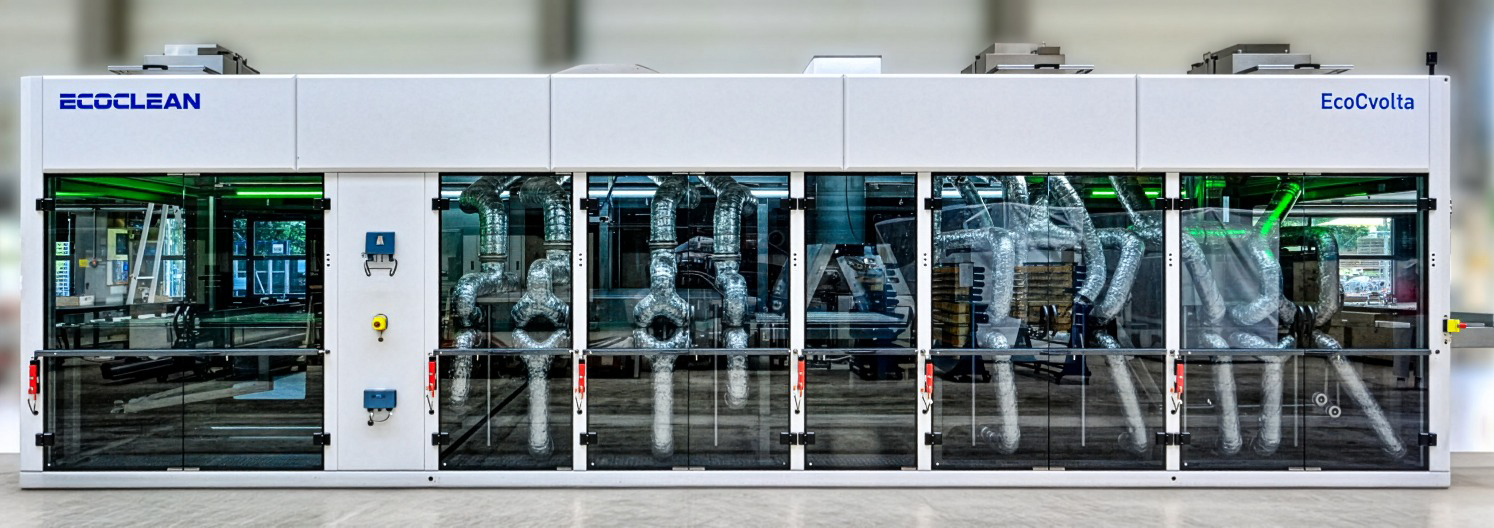
The EcoCvolta is a continuous-flow system for sensitive stamped parts in high volumes. Joachim Ritter and Peter Petzold developed it in Monschau together with other colleagues, which makes it the machine closest to Ritter’s heart.
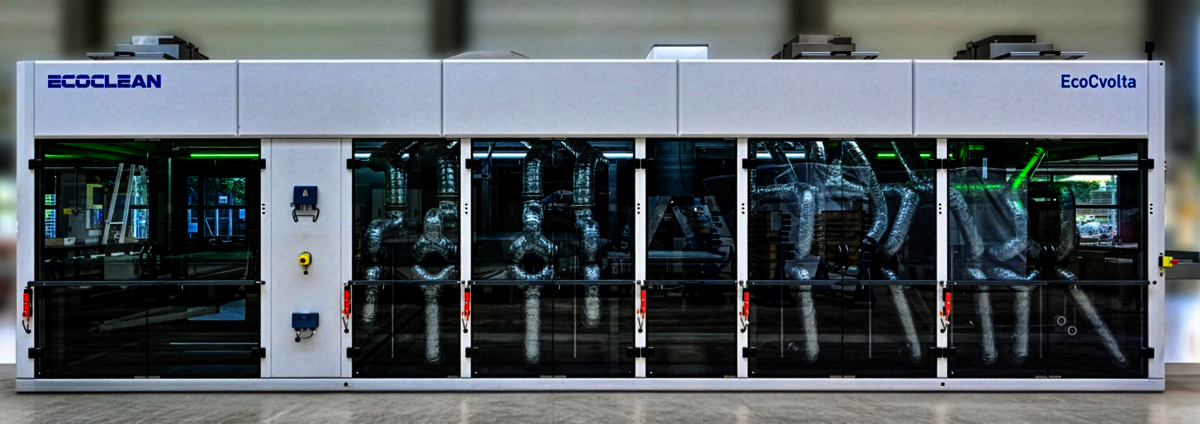
Modular Continuous-Flow Cleaning System
When stamped parts with sensitive geometries need to be cleaned in high volumes to high cleanliness standards, the EcoCvolta comes into play. The modular continuous-flow cleaning system integrates directly into high-volume production lines and achieves cycle times of 0.5 to 10 seconds.
What makes it interesting for stamping companies:
- Particle-free in continuous flow: Removes stamping and cutting burrs as well as particles. Depending on requirements, the maximum residual particle size is between 50 and 300 µm.
- Clean at the film and substance level, too: Oils, greases, and fingerprints are removed to achieve a surface tension of 38 to 48 mN/m. On request, surfaces are kept free of substances such as phosphorus, surfactants, sulfur, silicones, silicon, and organic compounds.
- Gentle on thin parts: Workpieces travel lying flat or standing upright on a rod-link mesh belt. A synchronized top belt holds them in place, even metal foils. Material thicknesses range from 0.05 to 20 mm.
- Modular like a building-block system: Each process step is a separate module, and the sequence can be freely selected. Possible combinations include spray and steam cleaning, thermal oil removal, high-pressure water-jet deburring, Hydrocleaning, CO2 blasting, laser cleaning, and plasma.
- No carryover, no recontamination: Separate conveyor belts for each module prevent cleaning media from being carried over. An optional glass enclosure and HEPA-filtered supply air ensure a clean atmosphere, and connection to clean zones or cleanrooms is possible.
- Designed for everyday operation: Belt widths from 300 to 1,300 mm, stainless steel in all process-relevant areas, generous maintenance access, and a belt change in about two hours (optional).
Bipolar plates for fuel cells show just how demanding this can get. They are stamped or embossed, but afterward they must be almost perfectly degreased and particle-free before they are coated. This is exactly the kind of task the EcoCvolta is designed for.
Test First, Then Invest: Trials at the Monschau Test Center
The best way to find out which process is right for a specific stamped part is to test the part itself. For this purpose, the Ecoclean Center of Competence in Monschau has a 460 m² test center. Here, our experts develop and validate new processes together with customers, using their original parts.
- EcoCvolta continuous-flow test system: two flexible wet and drying modules, a hot-air module for thermal oil removal, an 800 mm wide conveyor belt, 1 µm fine filtration, and a cleanroom enclosure at the outfeed. It is supplied with 1,000 liters of DI, reverse osmosis, or potable water that can be heated up to 60 °C.
- Additional test systems: the EcoCwave chamber system (3-tank), an ultrasonic multi-stage immersion system, and a high-pressure robotic cell up to 1,200 bar, as well as various immersion, spray, and ultrasonic processes.
- Cleanroom (ISO Class 7) and cleanliness lab according to VDA 19: automated cleanliness analyses with the Ecoclean Lab on Chip (LOC), gravimetric and microscopic analysis, endoscopic inspection, and roughness measurement for surface characterization.
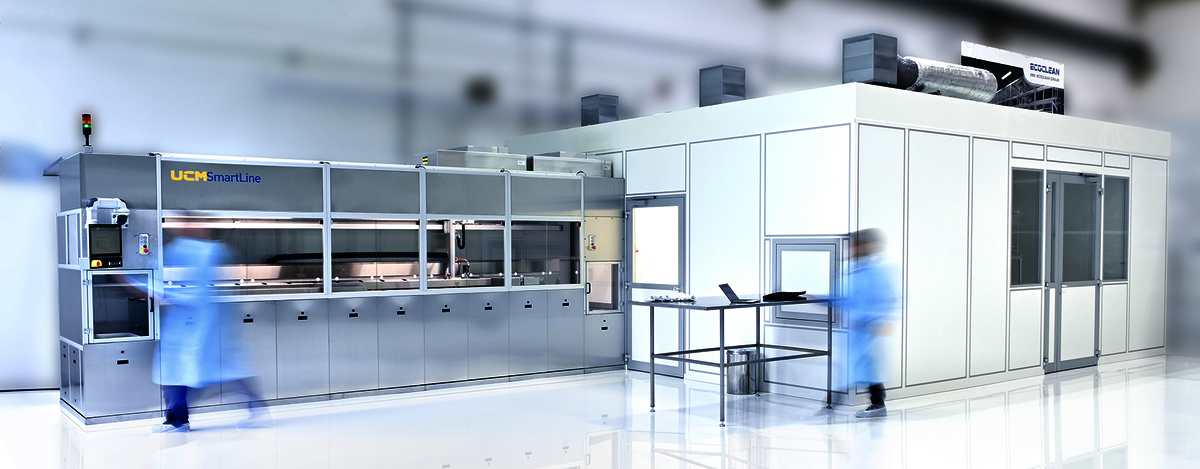
This is how “particle-free” goes from a guiding principle to a measured result: At the end of a trial, there’s not only a clean part, but also documented proof of which process reliably meets the required limit values.
Many thanks to MTI at RWTH Aachen University and to Raziol, Unidor TR systems, and FIBRO for a successful expert meeting.
Do you want to know how clean your stamped parts can get? Contact one of our Test Centers worldwide.
The expert team in Monschau, Germany, can help you find the center closest to you. Contact them at info.monschau(at)ecoclean-group.net


