


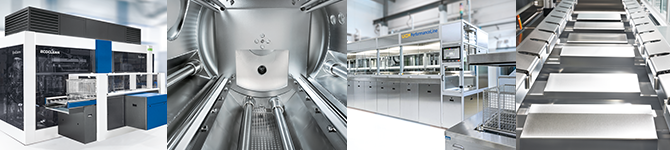




In many manufacturing facilities, parts cleaning faces a conflict of priorities: demands for component cleanliness are rising, but available space is not. This is exactly where the EcoCbase S comes in—a compact full-vacuum chamber system for industrial parts cleaning using non-halogenated hydrocarbons and modified alcohols, which is suitable for both cramped production halls and as a decentralized cleaning station in larger plants.
Cleaning media: Effective and reliable
The EcoCbase S operates with non-halogenated hydrocarbons and modified alcohols. These solvents enable the reliable removal of oils, greases, emulsions, and chips—all while maintaining low solvent consumption and low-emission operation.
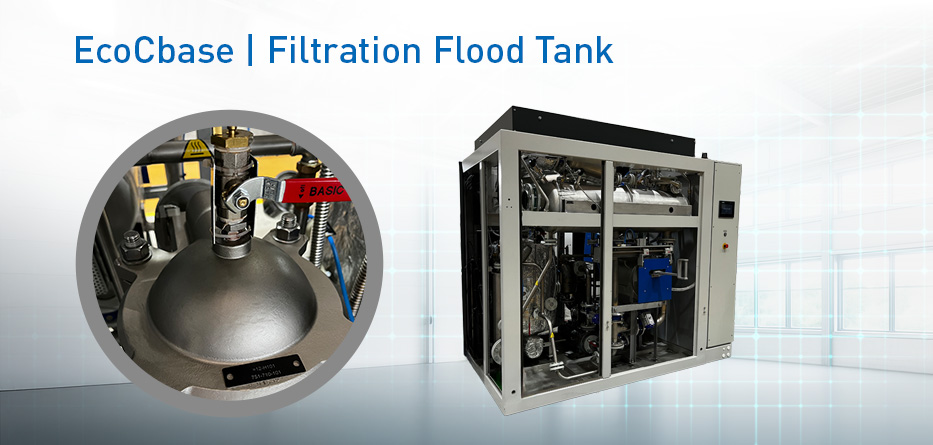
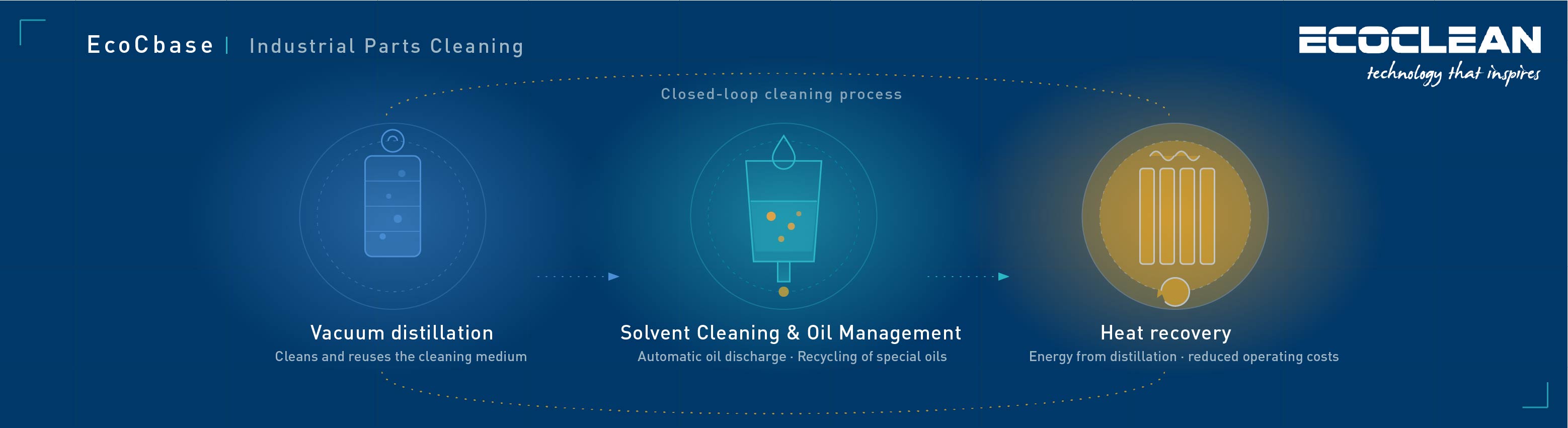
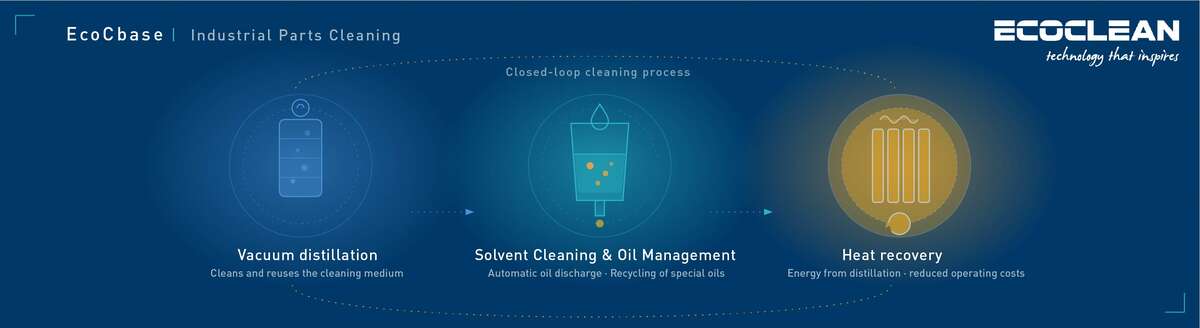
Continuous vacuum distillation (up to 50 l/h capacity, depending on the model) ensures that the cleaning medium can be continuously recycled and reused. This not only protects the environment but also significantly reduces operating costs.
Applications: Intermediate and final cleaning
The system is suitable for both intermediate cleaning—i.e., between individual production steps—and final cleaning. It thus covers the entire relevant range within a process chain. The EcoCbase S is particularly suitable for:
- Small businesses with lower capacities looking for a cost-effective and space-saving solution.
- Decentralized cleaning stations in larger production environments that need to respond flexibly to different parts and batch sizes.
- Small to medium-sized batches where a large-scale system would not be economically viable.
Closed-system cleaning processes
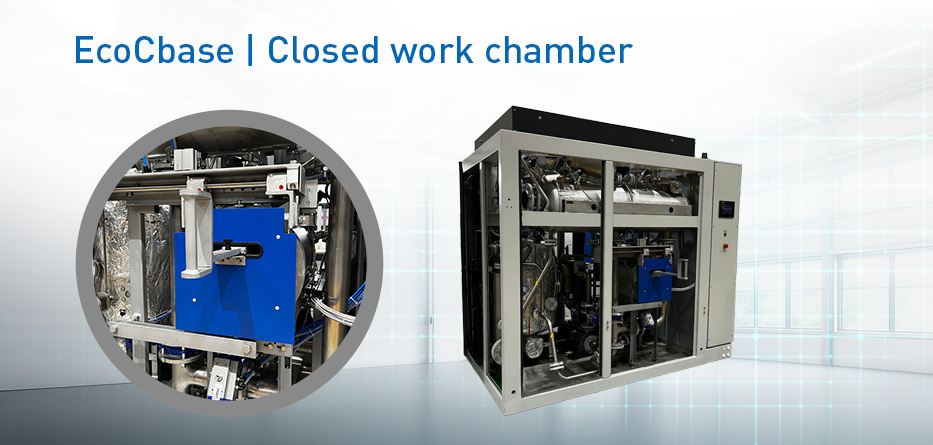
All cleaning processes take place in a vacuum-tight working chamber. This protects the solvent from uncontrolled evaporation and enables precisely controllable process conditions.
Depending on the cleaning task, various methods can be combined:
- Spray cleaning and injection flood washing form the basis and ensure comprehensive mechanical cleaning.
- Ultrasonic cleaning generates microjets on the component surface through cavitation, which mechanically dislodge contaminants—particularly effective for complex geometries.
Ecoclean’s proven application and technology are also suitable for smaller cleaning systems.
- Ultrasonic Plus (US+): The cavitation effect is enhanced by the targeted build-up of overpressure during ultrasonic treatment. This improves both bubble formation and the collapse of the cavitation bubbles, thereby increasing cleaning performance on the surface. At the same time, the pressure variation creates a slight pumping effect that also acts from the interior of the component.
- Pulsated Pressure Cleaning (PPC): The vacuum-assisted PPC process is available for components with hard-to-reach internal geometries, fine bores, or capillary structures. In this process, the pressure in the process chamber filled with cleaning medium is cyclically lowered and then raised again. This produces two cleaning effects: On the one hand, the pressure changes cause the medium to penetrate deep into cavities and capillaries; on the other hand, controlled vapor bubble formation and their collapse occur—even in shaded areas.
Automatic oil discharge: conserve resources, reduce costs
A frequently underestimated aspect of solvent cleaning is oil management. The EcoCbase S offers an optional continuous oil discharge system that automatically transfers used oil to external collection tanks. The solvent content in the discharged oil is significantly reduced (approx. 20%), enabling the recovery and reuse of expensive specialty oils.
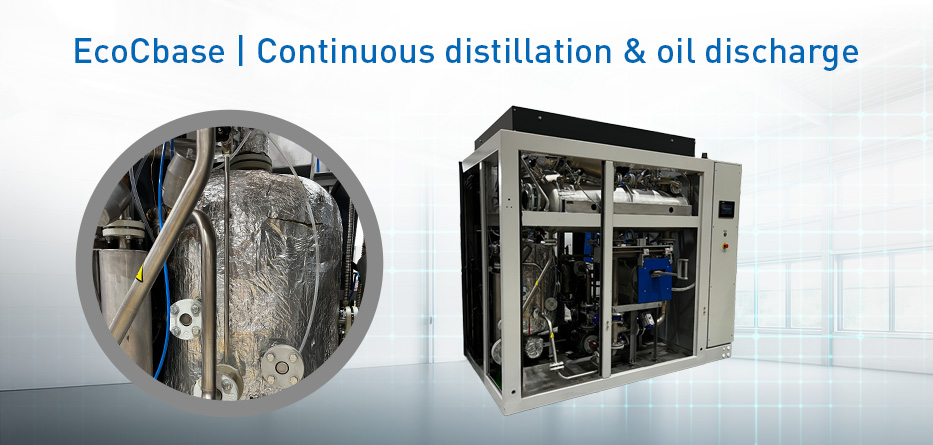
Technically, the system is designed for an oil consumption of up to 1.5 l/h, with a removal cycle of approx. 3.5 l/h from the distillation process. The containers are equipped with jacket heating to prevent sedimentation.
Cost-effectiveness through system design
The EcoCbase S is designed as a plug-and-play solution: full commissioning and customer acceptance take place prior to delivery. This significantly reduces on-site installation effort.
Heat recovered from the distillation process is used to heat the flood tanks—a simple yet effective principle for reducing energy consumption. During operation, average power consumption is 6–10 kW.
Additional economic benefits:
- Dual solvent filtration during filling and emptying of the working chamber.
- Frequency-controlled drive for the flood pumps (flow rate 20 m³/h) for optimal filtration and chip rinsing.
- Flexible basket dimensions up to 430 × 225 × 200 mm.
Operation and control
The system is operated via a 7-inch touchscreen HMI control panel. Up to 50 cleaning programs can be individually configured and saved. An integrated process visualization feature enables continuous real-time process monitoring and supports maintenance planning.
The Siemens PLC with a PROFINET interface and Ethernet connection ensures integration into existing production environments. Automatic pressure and temperature control increases process reliability and facilitates the validation of cleaning results.
Loading: manual or automatic
Depending on requirements, the EcoCbase S can be loaded manually or automatically.
For manual loading, access is via an electrically monitored flap. A 2-station loading table separates the dirty side from the clean side—an important aspect for process quality.
Automatic loading uses a roller conveyor with an integrated loading station. Height-adjustable guide rollers and a tunnel section to comply with legal safety regulations are integrated as standard. The specified cleaning program is automatically applied.
Conclusion: Small but mighty!
With a length of 2 meters, a depth of 1.4, and a height of 2.1 meters, it fits even in rooms with low ceilings—without compromising on performance.
The EcoCbase S is not a stripped-down compromise solution, but a full-fledged cleaning system in a compact format. It is suitable wherever high component cleanliness, limited space, and economical operation converge—whether in a small manufacturing facility or as a supplementary cleaning station within a larger production network. Through the combination of proven cleaning processes, sophisticated media management, and flexible configurability, it reliably covers a wide range of requirements.
Find out more about this solution here: https://ecoclean-group.net/de/produkte/ecocbase/
Our experts are available to answer your questions! Schedule a consultation now:sales.filderstadt(at)ecoclean-group.net
Alternatively, you can contact our Ecoclean experts in your area: https://ecoclean-group.net/contact/
Basic configuration ✓ = Included in the standard configuration | Optional upgrades + = Optional upgrade, depending on configuration and requirements |
Cleaning technology & media system | |
✓1 flood tank with pump and filter | +2 flood tanks – incl. pump and bag filter |
✓High-performance injection flood washing | +Magnetic insert (single/double), per bag filter |
✓Distillation | +Filling and emptying unit for Safetainer |
✓Vacuum unit | +Ultrasonic device 1 kW |
✓Steam degreasing | +Ultrasonic Plus (US+) |
| +Pulsed Pressure Cleaning (PPC) |
| +Surge protection package for ultrasonic |
Loading & Handling | |
✓Electropolished working chamber (chamber interior, door panel, turntable) | +Automatic loading |
| +Barcode scanner |
Controls & Operation | |
✓7-inch control panel, weekly/daily timer, 50 cleaning programs | +Process data logging |
✓Light bar | +Remote Service Ethernet |
| +Integration of Euchner EKS for user management |
| +Individual wire numbering |
Cooling & Power | |
✓System enclosure with floor tray | +Control cabinet cooling (air/water/compressor) |
✓Enclosure exhaust | +Cooling via cooling water |
| +External chiller, 9 kW |
| +Energy consumption meter with heating test function |
| +Compressed air meter |
Additional options | |
| +Design packages |
+Machine qualification packages | |
+Special clamping options | |
Great to know!
What is …Pulsated Pressure Cleaning (PPC) |
Vacuum-assisted | Effective even in cavities and bores | Geometry-independent |
PPC is a vacuum-assisted cleaning process for components with hard-to-reach internal geometries, fine bores, and capillary structures. The pressure in the process chamber filled with cleaning medium is lowered and raised again in short cycles—this creates two complementary cleaning effects: |
|
|
What is …Ultrasound Plus (US+) |
1 kW ultrasonic (basic configuration) | Option: Ultrasonic Plus (US+) |
Ultrasonic cleaning generates vapor bubbles on the component surface through cavitation. When these bubbles collapse, microjets are created that mechanically dislodge contaminants. |
|
|
|
|
What is …Continuous oil discharge |
Up to 1.5 L oil consumption/h | approx. 20% solvent content in used oil | approx. 3.5 L/h extraction cycle |
The oil discharge system ensures continuous processing of the cleaning medium. Used oil is automatically transferred to external collection tanks—with reduced solvent content, which enables the recovery of expensive specialty oils. |
|
|
|
|


